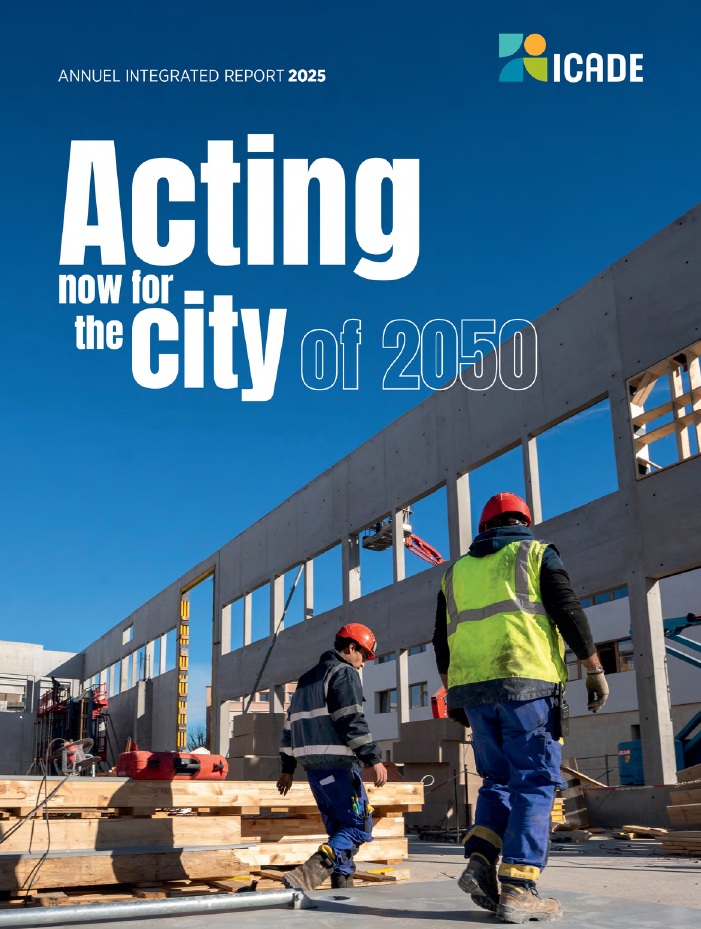
Against a backdrop of challenging market conditions, 2025 was marked by significant successes and numerous advances in the implementation of the strategic plan. Progress on projects, strengthened CSR objectives and a diversification strategy well underway: the 2025 edition of this integrated annual report is packed with these developments, with a particular focus on the city of 2050.
“
We are confident that the diversification strategy we are currently pursuing will create long-term value for the Company. The development of student residences is already well underway, we are stepping up our datacenter activities and we have embarked on a transformative journey to meet our goals, namely to build the city of 2050 today and satisfy the needs of local authorities, customers and partners.
Nicolas Joly
CEO of Icade
2025 was a year of transformation. Despite a challenging market environment, we are moving forward. We are building. We are delivering.
We combine two core businesses. Two areas of expertise.
On the one hand, our property division takes a long-term view, holding and enhancing the value of our existing portfolio. On the other, Icade Promotion designs, builds and delivers the projects of tomorrow. This dual role changes everything: we operate across the entire chain, from buildings already in use to neighbourhoods taking shape today.
The result? We understand users’ real needs. We have a firm grasp of urban challenges. We support local areas in their concrete, tangible transformation.
We want to be a leading player in the fight against climate change. And to achieve this, we are taking action.
In 2025, we are updating our low-carbon pathway. Our 2030 targets? Aligned with a +1.5°C pathway, in accordance with the new SBTi standard. What does this mean in practice?
The result? We are reducing our carbon footprint, year after year, to build a city that breathes.
How can we transform our cities to prepare for 2050? We put this question to public and private sector stakeholders who gathered for a discussion on 9 September 2025. Tech cities, community-focused cities, social housing, decarbonisation, regional transformation: these are all issues that call for concrete solutions, tailored to each region.
In short, solutions do exist. Experiments are being carried out at the level of neighbourhoods and buildings, in France and elsewhere. And this requires dialogue and collaboration between all those who build the city. For those who live there, who work there, who find warmth and serenity there.
In 2025, we also brought together employees, experts and entrepreneurs around a shared ambition: to invent the solutions of tomorrow. In practical terms? It is an internal initiative involving the company’s managers and experts to bring about a profound change in the way we do things.
Climate change, an ageing population, land development: we must adapt. We are launching a multi-phase collective initiative. First, we will engage our staff to identify the key challenges. This will be followed by a design thinking phase and workshops to develop new offerings, which will be presented to all staff.
Led by Sonia Lavadinho, an urban anthropologist, and Maud Caubet and Madeleine Masse, architects, these workshops involve more than 60 staff members. The aim? To give concrete form to our thinking about the city of 2050.
Living organisms. Demography. Urbanisation. The building’s life cycle. Eight workshops explore these in depth: the role of the flagship building as a refuge; living with the elements rather than against them; intergenerational buildings; nomadism and transhumance; the renaturation of infrastructure; green equalisation; the flexible-use ‘spinning top’ building; and methods to ensure buildings last the century.
From April 2026, we will be rolling out our new offerings. We are presenting local councillors with practical solutions for building the city of 2050. In short, we are moving from ideas to action. We are reinventing the property sector; we are building a city that breathes, adapts and endures.